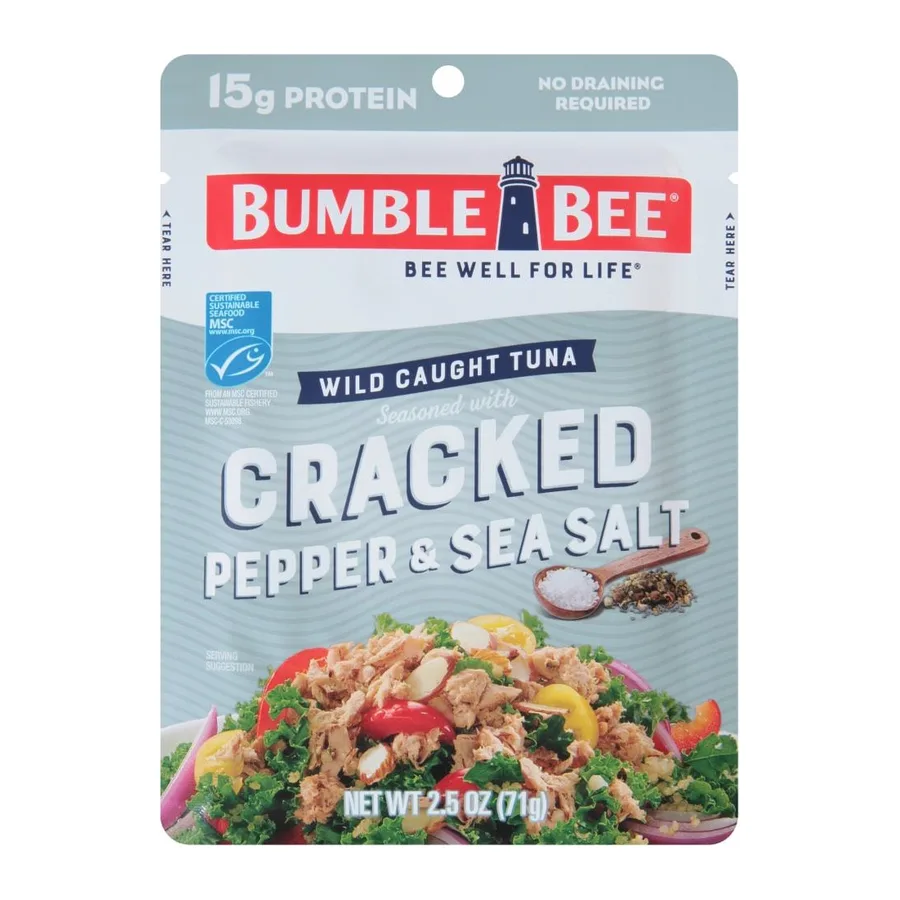
Seasoned tuna, cracked pepper & sea salt
Is Bumble Bee Seasoned tuna, cracked pepper & sea salt OK for gout?
In small amounts.
Rated down for its main ingredient, with up to 159 mg of purine a serving.
- Purine a serving
- up to 159 mg
- Fructose
- 0 g
- Added sugar
- 0 g
All 33 on the canned tuna shelf rate D
Why D?
In small amounts. It rates D (Limit), held there by its main ingredient, with up to 159 mg of purine a serving.
- Main ingredient: light tuna, rated like canned tuna (D)GoutSafe ↗
- Purine: up to 159 mgGoutSafe ↗
- No added sugar
- Contains yeast extractGoutSafe ↗
GoutMarket grade · all 33 on the canned tuna shelf rate D · Updated Nov 15, 2026. Every reason and source · The numbers
Purine and sugar, by the numbers
| Serving | 1 pouch (71 g) |
|---|---|
| Purine per serving | about 99 mg, at most 159 mg (40% of the 400 mg daily guide) |
| Purine per 100 g | at most 225 mg |
| Purine before GoutSafe's weighting | at most 159 mg per serving |
| Main purine source | canned tuna · Measured · USDA |
| Fructose per serving | 0 g |
| Added sugar per serving | 0 g |
| Total sugar per serving | 0 g |
Where the purine comes from
| Ingredient | Matched GoutSafe food | Purine in that food, per 100 g | Share of the product | Purine at that share, per serving | Counted in the worst case |
|---|---|---|---|---|---|
| light tuna | canned tuna (D) · Measured · USDA | 212 mg | up to 100% | 150 mg | 147 mg |
| yeast extract | dried yeast (D) · Measured · USDA | 847 mg | up to 2% | 12 mg | 12 mg |
| cracked black pepper | red and green bell peppers (A) · Measured · USDA | 1 mg | up to 2% | under 1 mg | under 1 mg |
Purine values come from each matched food's page on GoutSafe. Shares come from label order: US labels list ingredients by weight, so the second ingredient is at most half the product, and anything after "2% or less" is at most 2%. Plain yeast and hops, and anything the label marks as color or to keep it fresh, count at no more than 2% and yeast extract at no more than 5% wherever they sit, since recipes use them in small amounts. The worst case fills the most purine-dense ingredients to their full share first, until the shares reach the whole product, then applies GoutSafe's weighting by source, which counts plant purines at 0.3, dairy at 0 and organ meat at 1.3. Those weights are GoutSafe's model, set from a 12-year cohort of 47,150 men in which meat and seafood raised gout risk, purine-rich vegetables did not, and dairy lowered it (Choi 2004). The study gives risks by food group, not these factors. The grade uses that worst case. How we rate.
Why it's rated D
- Its main ingredient, light tuna, which GoutSafe rates like canned tuna, is graded D on GoutSafe, and a product never rates safer than its main ingredient. Source on GoutSafe.
- About 99 mg of purine per serving, and at most 159 mg (40% of the 400 mg daily guide), mostly from canned tuna. Source on GoutSafe.
- The Nutrition Facts panel lists 0 g of added sugar per serving.
- Yeast extract is one of the most purine-dense ingredients there is, at 847 mg per 100 g dried. Source on GoutSafe.
Estimated from the ingredient label. Labels list ingredients by weight but rarely give amounts, so we grade on the most purine the label allows, which can read stricter than the real recipe and never safer. Sugar comes from the Nutrition Facts panel. How we rate.
What's on the label
Ingredients: LIGHT TUNA, WATER, 2% OR LESS OF SEA SALT, CITRUS FIBER, CRACKED BLACK PEPPER, MODIFIED CORN STARCH, YEAST EXTRACT, GUAR GUM, NATURAL FLAVOR
Serving: 1 pouch (71 g). Added sugar: 0 g per serving. Label from USDA FoodData Central (record 2599198), dated 2023-07-13. UPC 086600240961. This label is over a year old and the recipe may have changed. Check the package.
Compare canned tuna with other foods
Where to buy
Prices change often, so we don't show them. The rating is the same whichever store you pick.